

Honoring What Cannot Burn
Legacy is what carries forward, not what is left behind.
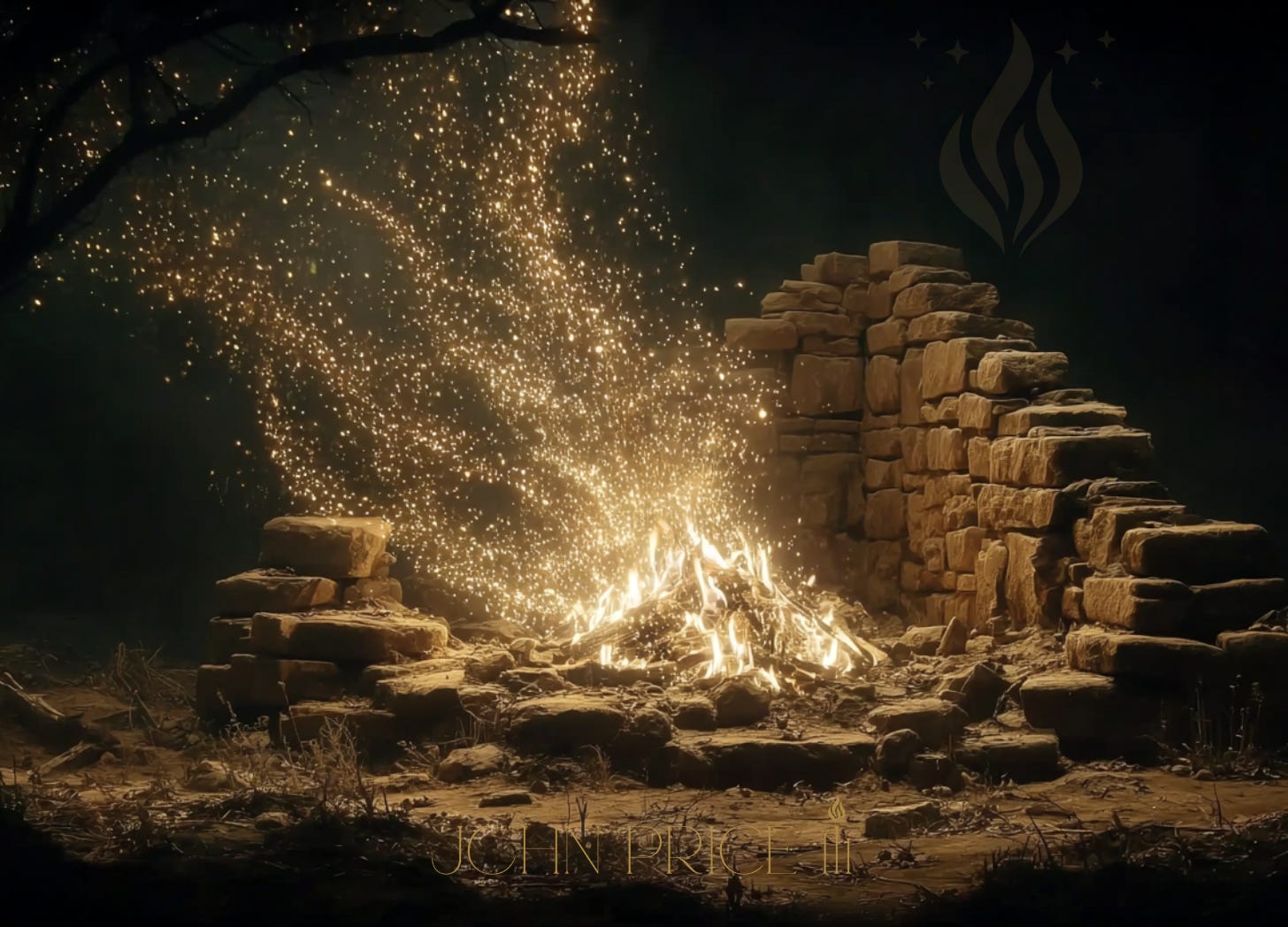
Twelve years ago, for my 40th birthday, my mother gave me a box.
It was filled with photos, cards, artwork, and other memorabilia from my childhood — including, somewhat memorably, some of my baby teeth. My response was immediate and loving: Mom. This is weird. We need to talk.
We laughed. We went through it together, the family gathered around, pulling things out and trading stories. I genuinely loved that afternoon. Then I packed it all into my suitcase, brought it home, and put it into storage where it joined the other boxes. It stayed, moving from place to place with me across the years.
As though somehow, those containers held my identity and my memories.
Even though I already knew they didn’t.
I learned something early about the nature of things you cannot yet hold in your hands.
My grandfather was a man of grand promises. Generous with them, lavish even — the trips we would take, the things he would give us, the futures he painted with the particular confidence of someone who had no intention of being held to any of it. I loved him. I also learned, quietly and early, that a promise is just words until it becomes something you can actually touch.
That lesson shaped me in ways I am still finding. It made me practical about what is real. It made me slow to count on what hasn’t arrived yet. It also, I think, made me carry things I didn’t actually need. If it was in my hands, at least I knew it existed.
The boxes were, in their own way, a version of that. Proof of a life. Evidence that the years had happened, that I had been a child once, that I have been loved and remembered and these items were saved by people who thought these things might someday matter to me.
Most of them didn’t, or at least not in the way Mom had probably hoped. Not in the way I kept pretending they might.
Last weekend, in the cleansing energy of fire, I let most of it go.
The speech therapy reports. The participation ribbons. The scripts from school plays. The Funshine Care Bear folder I had genuinely, completely loved in elementary school. Photos of people I haven’t spoken to since high school, of moments that live only in my memory and would mean nothing to anyone else who held them. Greeting cards. Finger paintings made at four years old with the full conviction of an artist who had no idea yet what art was.
I fed them to the fire with gratitude and without grief.
What I noticed, sitting with the release, was this: I had not been carrying those things for myself. Not really. I had been carrying my mother’s care. The tenderness of a woman who had held onto the artifacts of my childhood because they meant something to her at some point, and she believed they would eventually mean something to me. I kept them not because they did, but because she gave them to me, and releasing them felt like a disrespect to her 40 years of keeping and guarding them. How long I held onto things that others had given simply because they were gifts. Not for any other reason other than they were a gift, and gifts are to be cherished.
I know from the depths of my heart that these things were curated and kept with love, fondness, and deep sentimental attachments.
Releasing these things has left the love exactly where it has always lived — in me, in her, in the people represented in the cards and photos, in the years and memories that no fire can touch.
There is a particular kind of sovereignty in releasing what was good.
We talk often about letting go of what hurt us. The relationships that took too much. The patterns that no longer serve. The beliefs we absorbed from environments that couldn’t hold us. That release has its own weight and its own work and its own particular grief.
Releasing tangible manifestations of what was simply precious — what was innocent and light and genuinely loved — that asks something different of you. It asks you to trust that you are not your artifacts. That your identity does not sit on a shelf or live in storage containers. That the Funshine Care Bear folder and the smeared finger paintings and the baby teeth in a small envelope were never the evidence of who you are. They were just things. Beloved things. Things that had their season and had been honored and could now, finally, return to the element they came from. Ashes to ashes. Dust to dust.
Three boxes became one. The fire (and the trash bin) did the rest.
I will not leave behind a museum. I know this.
When I am gone, and I say this not from sadness but from the particular clarity that comes from facing something true, what I have built digitally will disappear with the swift click of a button or the expiration of a subscription. The Substack, the program, the website. All of it is impermanent in ways that a box in a storage unit is not, ironically. The physical goes eventually, the digital goes faster.
What remains, if anything remains, is what moved through people while I was here. A reflection that named something someone had never been able to name. A participant who found their way back to themselves inside a container I built because I needed it and it didn’t exist yet. A story passed down through a friend or family member, a niece or nephew or their children, growing more embellished and less accurate with every generation until it becomes something between myth and memory.
I will accept my legacy being a smile on someone’s face.
That is not a small thing. It is also not a permanent thing. Nothing is.
There is a freedom in that — a lightness that feels, if I am honest, not unlike watching the memorabilia of my life burn. The release of needing what remains to be significant. The permission to have simply lived, and loved, and built what felt true, and trusted that whatever of it was real will find its way into whoever needed it.
The rest can go.
It was never mine to keep.
What are you carrying that belongs to someone else’s love rather than your own need? And what might become possible if you trusted that releasing the artifact does not release what it represented?
I’d love to hear what this brought up for you.
Your reflections are part of the medicine, and every voice adds to the remembering of our collective sovereignty.
If this reflection landed for you, I’ve created a short quiz to help you discover your Inner Sovereign Archetype — which aspect of your sovereignty is ready to emerge.
You’ll receive a personalized reflection plus a 3-day email sequence tailored to your path.
If something within this reflection stirred you, consider sharing it with someone who’s walking their own path of becoming. The ripples begin when we share the light we’ve found.
If you’re new here, welcome. I started Reflections from the Temple to be a space for those returning to their center — one breath, one truth, one remembrance at a time. Subscribe to receive each new reflection directly in your inbox.
Beautiful!
Ah such beautiful intense emotions coming up as always John! I used to be a hoarder as my mom used to say. Taking care of everything from friendship bands to school uniform to class photos. I still have them. Oh and the journals! Fought with my mom tooth and nail to keep them while she kept saying I was filling the house with nonsense haha.
Reading your words I realise that those pieces don't hold that much power over me as they did before. But they also bring me a weird comfort with their existence. Even if I don't check on them frequently...knowing that they still exist makes me feel nice. I don't know what it means though. But I felt that someday I'd be ready to let go of them completely...and I'm not gonna force that day to come by you know?
Another thing that came up deeply was that I want to store everything of my kids too. Hopefully not the teeth😝. But yeah everything else. Because I want them to have a choice whether to have or throw. It should be their choice. Not mine. I didn't have it a lot of times so I want to give it to them.